There are two ways to deal with compressor lubricant in your gas stream. Most plants choose the expensive one.
Inside a gas processing facility, the gas stream passes through amine treating, dehydration, molecular sieve beds, NGL recovery, cryogenic exchangers, residue-gas compression, and custody-transfer metering—steps that are sensitive to the lubricant that contaminates the gas stream when it carries over from reciprocating compressor operations. Divider block lubrication systems serving compressor cylinders and packing are once-through systems: the oil is consumed in the process and ultimately leaves with the gas stream. Every gallon of excess lubricant becomes a process contaminant—not just a lubrication expense.
The Common Fix: Capture it Downstream
The conventional response is to catch the oil after it enters the gas stream—knockout vessels, mist eliminators, filters, and coalescers.
The results can be dramatic. At one 600-MMscfd cryogenic gas plant, upgraded coalescers prevented compressor lubricant contamination from reaching critical cryogenic equipment, increasing propane recovery from 90% to more than 99% and creating more than $5 million per year in value per train. The investment reportedly paid for itself in just one to two months.
But the same study highlights the scale of the underlying problem. Before the upgrade, approximately 56 gallons of compressor lubricant per day were calculated downstream of the existing coalescer system with three compressors operating.
A separate measurement study demonstrated how lubricant contamination can impact custody-transfer accuracy. After cleaning an oil-contaminated meter tube, the difference between the primary meter and check meter improved from 0.5% to 0.03%. Published industry data also estimated that a 0.1% metering error at a 100-MMscfd facility could represent more than $100,000 per year in commercial exposure, illustrating how carryover can create costs far beyond the lubricant bill itself.
The lubricant itself is not the biggest expense.
The real costs come from where that lubricant ends up:
- Fouled filters and coalescer elements
- Recovered oily waste requiring disposal
- Compressor valve wear and maintenance
- Meter contamination and measurement uncertainty
- Amine-system foaming and contamination
- Molecular sieve degradation
- Cryogenic process inefficiencies
- Reduced equipment reliability and increased downtime
Plants often pay for the same lubricant multiple times:
- Buy it.
- Inject it.
- Capture it.
- Dispose of it.
- Repair the problems it creates.
The lubricant bill is often only the first invoice.
Why inject more lubricant than the compressor needs, then pay again and again to remove the consequences?
The Better Fix: Solve the Root Cause
Reducing over-lubrication cuts the oil load at its source.
Sloan Lubrication Systems specializes in divider block lubrication systems for reciprocating compressors. Our approach starts with understanding the application, establishing the proper lubricant requirement, and identifying the solution that delivers the best combination of reliability, contamination reduction, and operating-cost improvement.
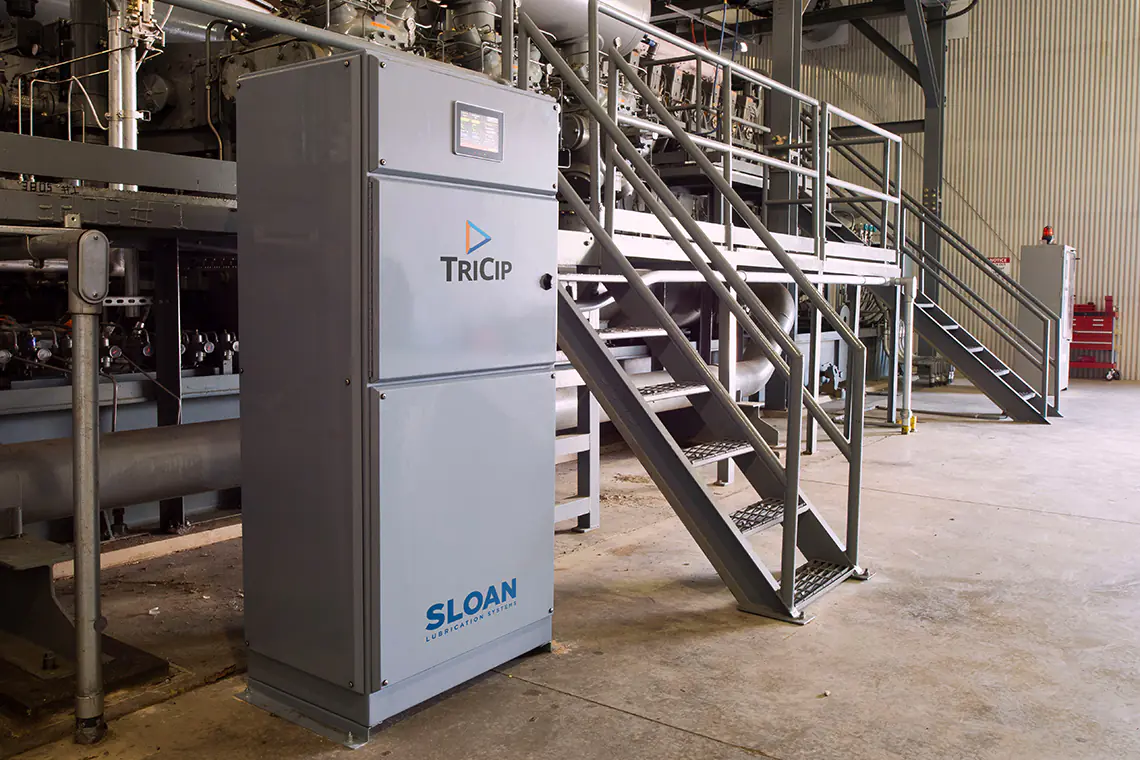
For many applications, that solution is the TriCip Lubrication System.
TriCip combines advanced lubricant delivery technology with a proprietary cylinder lubricant to reduce compressor cylinder lubrication rates by up to 90%, dramatically reducing lubricant carryover while maintaining compressor protection. Published operating results from a major pipeline operator documented:
- 134 compressors
- 35 stations
- More than 1.1 million run hours
- 81,000 fewer gallons of lubricant used
- 56% reduction in unplanned valve-maintenance hours
- Elimination of filter fouling and associated downtime in many applications
Those results represent far more than lubricant savings. They reflect cleaner gas streams, reduced contamination, improved reliability, and lower operating costs throughout the system.
Other Sloan solutions—including our Watchman System and Custom Systems—can often achieve lubricant reductions approaching 50%, depending on the application, while providing monitored, fail-safe lubricant delivery and reliability improvements. The key is selecting the right solution for the compressor and operating environment.
The Capital-Planning Question
High-efficiency coalescers are a valuable line of defense.
But before investing in additional downstream cleanup equipment, it is worth asking whether the contamination can be reduced at the source first.
Recent industry examples have documented planned filter/coalescer installations costing nearly $1 million per installation. Internal Sloan estimates indicate that source-reduction projects can often be implemented for a fraction of that cost while simultaneously reducing lubricant consumption, contamination, maintenance burden, waste handling, and downstream process impacts. Unlike filtration equipment, those operating-cost reductions continue to pay dividends year after year.
Solve More Than the Symptom
The question is not whether you need separation equipment. Most plants do.
The question is whether that equipment is being asked to remove oil that never needed to be injected in the first place.
Before adding equipment to capture excess lubricant downstream, determine how much lubricant your compressor actually needs.
Sloan Lubrication Systems will evaluate the application, benchmark current lubricant consumption, and identify whether TriCip, The Watchman, or a Custom System will deliver the lowest contamination and total operating cost for your facility.
Did You Know:
We are always on call. Whether you have a need for emergency service, a rush order for parts, technical support, or are just looking for help with preventative maintenance tips, with Sloan Lubrication Systems on your side, you can always quickly reach a lubrication system expert to help you solve your problems.